Most home cooks treat chopping as a purely practical step — get the vegetable small enough to fit in the pan and move on. But the moment a knife meets a carrot or a head of broccoli, a cascade of chemical, structural, and biological changes begins. The size, shape, and surface area you create don't just affect how quickly something cooks; they directly determine how many nutrients survive, how much flavor is released, and what texture ends up on your plate. Understanding the science behind the cut transforms knife work from a chore into one of the most powerful tools in a health-conscious kitchen.
Surface Area: The Master Variable
Every cut you make exposes new internal surface to the outside world — to heat, to water, to oxygen, and to other ingredients. This is the central concept that links all of cutting's effects. A whole potato and a finely diced potato are chemically identical before cooking, yet they behave almost like different ingredients once heat is applied, because their ratio of surface to interior volume is radically different.
Larger surface area means faster heat penetration, faster moisture loss or absorption, faster chemical reactions, and faster nutrient degradation. Smaller cuts cook quicker, which sounds efficient, but that same speed cuts both ways nutritionally.
As an Amazon Associate, I earn from qualifying purchases.
Nutrient Loss: Where Your Vitamins Actually Go
Cutting vegetables increases their surface area exposed to heat, water, and air, which accelerates the leaching of water-soluble vitamins such as vitamin C and B vitamins during boiling. This is one of the most practically important facts in everyday cooking. When you boil finely diced zucchini versus large chunks, the diced pieces are surrendering a proportionally greater volume of their interior to the surrounding water, and the vitamins dissolved in cell fluids migrate into that water rapidly.
This doesn't mean you should avoid cutting vegetables small — it means you should think carefully about your cooking method in relation to your cut. Steaming, roasting, or stir-frying minimizes the water contact that causes leaching. If you do boil small-cut vegetables, consider using that cooking liquid in soups or sauces, where the migrated vitamins are still available to eat. The nutrients don't disappear; they relocate.
Fat-soluble vitamins — A, D, E, and K — are far less vulnerable to water-based leaching, though they can still degrade with prolonged high heat. For these, the cut matters less than the cooking temperature and time.
If you're focused on getting the most from vitamins and minerals in your diet, adapting your cutting style to your cooking method is one of the most straightforward adjustments you can make.
The Broccoli Case: When Resting After Cutting Is Worth It
Broccoli offers one of the most compelling demonstrations of how cutting technique interacts directly with specific phytochemical reactions. A study published in the Journal of Agricultural and Food Chemistry found that cutting broccoli and then allowing it to rest before cooking preserves higher levels of sulforaphane by giving the enzyme myrosinase time to convert glucosinolates before heat destroys the enzyme.
Here's what's happening: glucosinolates are the precursor compounds in broccoli, and myrosinase is the enzyme that converts them into sulforaphane — a compound strongly associated with anti-inflammatory and potentially cancer-protective effects. Both compounds are present in intact broccoli cells but are physically separated. Cutting brings them into contact. Heat then destroys myrosinase relatively quickly, so if you chop and immediately steam, you lose much of that enzymatic conversion window.
The practical takeaway is straightforward: chop your broccoli, let it sit for around 40 minutes, then cook it. The enzyme has already done its work before the heat can interfere. This is a case where the act of cutting and the timing around it matters more than the cooking method itself.
Flavor Release: More Surface, More Taste
Cutting doesn't just expose nutrients — it exposes flavor compounds. Onions and garlic are the clearest examples. When their cells are ruptured, sulfur-containing compounds react with enzymes to produce the sharp, pungent flavors we associate with raw alliums. A coarsely chopped onion has fewer ruptured cells per piece than a finely minced one, which is why minced garlic tastes noticeably more intense than sliced garlic, even in the same dish.
This matters for recipe outcomes in concrete ways. A rough chop of garlic added to a slow braise will mellow and sweeten dramatically. Minced garlic added to a quick stir-fry retains far more of its bite and sulfurous punch. Neither is wrong — they're different flavor tools achieved through knife technique alone.
Herbs follow a similar logic. Tearing basil rather than cutting it ruptures fewer cells and releases less of the volatile aromatic oils all at once, which is why torn basil in a salad tastes brighter and fresher for longer than sliced basil.
Enzymatic Browning: Why Your Basil Turns Dark
Chiffonade cutting (thin ribbon slices) of leafy greens like basil causes rapid enzymatic browning at cut edges due to the oxidation of phenolic compounds by the enzyme polyphenol oxidase, which is why basil darkens quickly after slicing. This reaction — identical in principle to what happens when you cut an apple — is triggered by the contact between the enzyme and oxygen at the newly exposed surface.
A sharper knife causes less cell damage along the cut edge compared to a dull blade, which tears and crushes rather than slices cleanly. This means a honed knife genuinely produces less browning and oxidative damage, not just aesthetically but at the cellular level. For herbs and spices where freshness is the whole point, knife sharpness is a nutritional consideration as much as a culinary one.
To further minimize browning, cut herbs at the last possible moment and consider tossing them with a small amount of acid (lemon juice or vinegar), which inhibits polyphenol oxidase activity.
Texture: How Shape Determines Mouthfeel
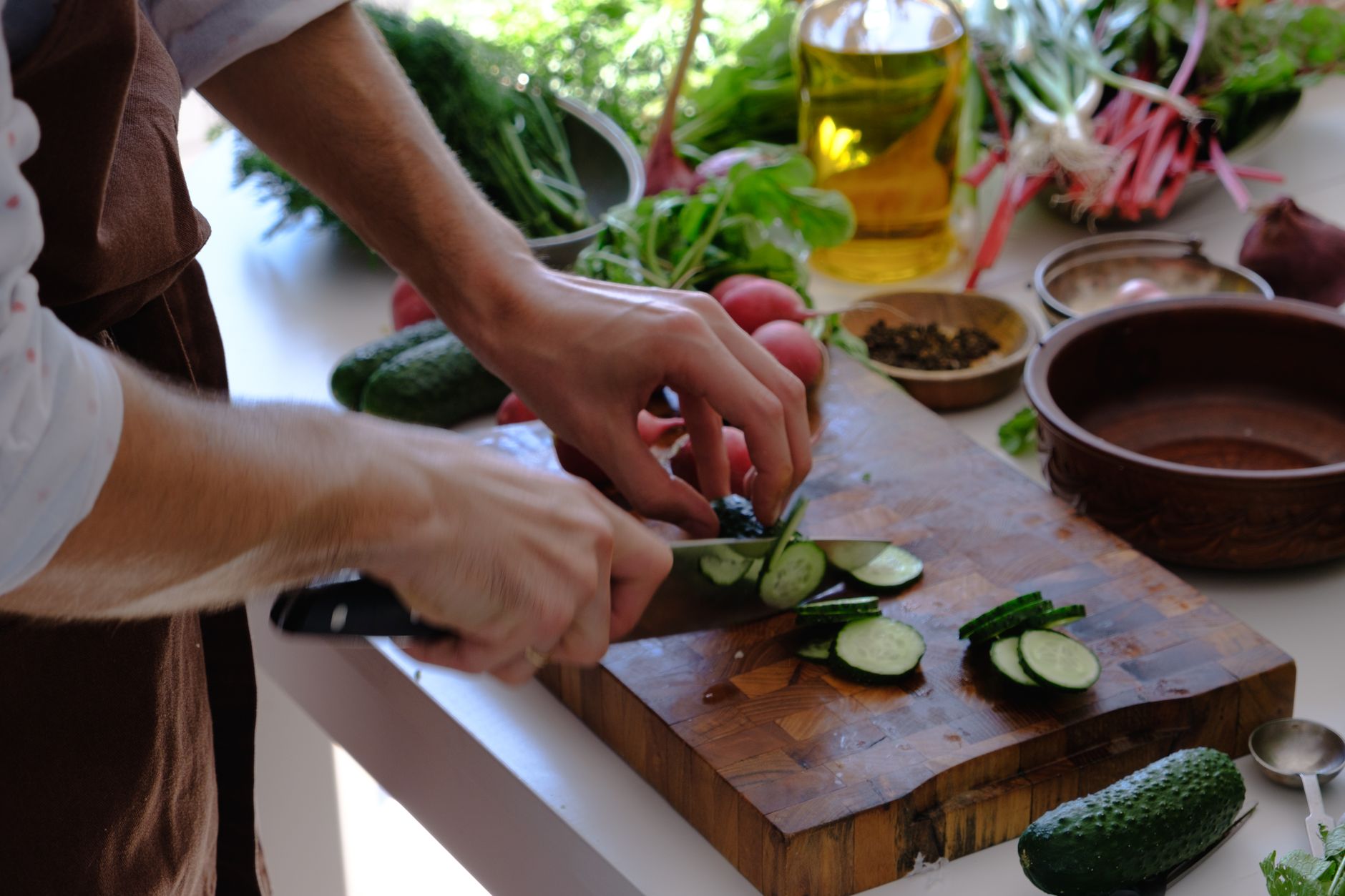
The geometry of a cut changes how a vegetable experiences heat in three dimensions simultaneously. A julienne strip (long, thin matchstick) has two long, exposed sides and cooks from multiple angles at once, resulting in quick, even softening. A large dice holds heat at its core longer, leaving the exterior softer than the interior if cooking time isn't calibrated carefully — which is actually useful when you want a roasted vegetable with a caramelized crust and a firmer center.
Irregular cuts — the kind produced by rough chopping — create uneven cooking by design. Some pieces finish before others, giving a dish a range of textures from just-tender to slightly soft. Whether that's desirable depends entirely on the dish. A rustic vegetable soup often benefits from that variability. A stir-fry generally doesn't, which is why uniform cutting is emphasized in professional Asian kitchen technique.
Bias cutting (slicing at an angle rather than straight across) increases the exposed surface of fibrous vegetables like celery or asparagus without making pieces smaller. This accelerates cooking and flavor release while maintaining an appealing, larger visual size — a useful technique when you want both speed and presentation.
Cooking Method Should Dictate Your Cut
Boiling and Braising
Use larger cuts to minimize nutrient leaching into the cooking liquid. If small pieces are needed, consider reducing the cooking time aggressively and saving the liquid.
Roasting
Uniform medium-to-large cuts give you even caramelization without burning edges before centers are cooked through. More surface area here is generally a benefit — it means more Maillard reaction (browning) and more concentrated flavor.
Stir-Frying
Thin, uniform cuts are essential. High heat, short contact time, and constant movement mean every piece needs to cook at the same rate. This method is actually one of the better ones for nutrient preservation despite the high heat, because cooking time is so brief.
Raw Preparations
Here, the cut is entirely about texture and flavor release with no heat degradation at all. Thin slices maximize flavor-compound release; thicker cuts preserve crunch and structural integrity. Neither is nutritionally superior, but fine cuts will oxidize faster, so timing matters.
Practical Rules Worth Keeping
A few principles pull all of this together into usable habits. First, match your cut size to your cooking method — small for quick-cooking methods with minimal water, larger for boiling or slow cooking. Second, for broccoli and other brassicas, cut first and wait before applying heat. Third, use a genuinely sharp knife to minimize cellular damage, particularly for delicate herbs. Fourth, the more finely you cut something, the sooner you should cook or eat it — cut surfaces are biologically active and degrading from the moment they're exposed.
None of this demands precision surgery at the cutting board. It just asks that you think of the knife as a scientific instrument as well as a kitchen tool — because that's exactly what it is.
Sources
Every factual claim in this article was independently verified against the following sources:
- You're Losing Half Your Vegetables' Nutrients Before They Hit Your Plate - Health & Wellness Canada — healthcouncilcanada.ca
- For Best Nutrition, Chop Broccoli Into Small Pieces Before Cooking, Study Finds - Newsweek — newsweek.com
- Enzymatic Browning - an overview | ScienceDirect Topics — sciencedirect.com